
AI Propaganda
It’s silly season

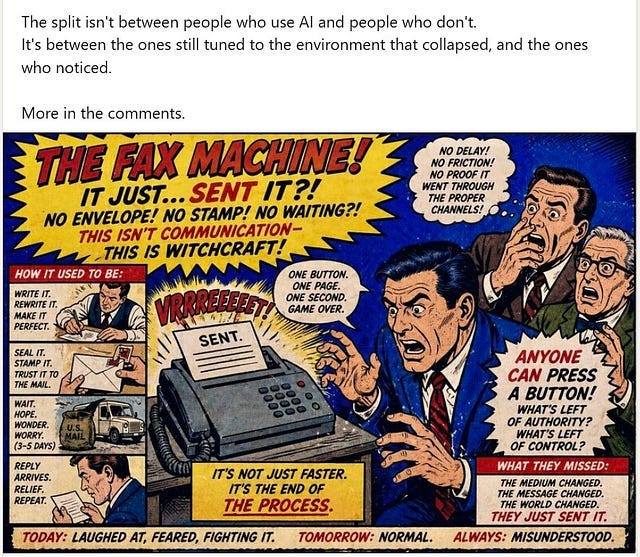
How does propaganda work? The propagandists use fictions to exploit and accentuate a real prejudice. Many propagandists also include mockery of anyone who doesn’t accept as true the fictions within the propaganda.
The above image is an example of propaganda; a screen grab I took from LinkedIn. It was posted by someone who uses LinkedIn to sell his consultant/coach services on how everyone needs to use AI. So, of course, he wants to convince everyone that AI is wonderful and that being against AI is a character flaw.
Those are his goals with this propaganda image, which was no doubt AI generated; one of his many posts selling his services. This image is heavy on the mockery of anyone who doesn’t accept as true the fictions pushed in his pro-AI propaganda. What struck me about this image was its particularly outrageous fictions, reminding us of the attitude behind AI and the scam it’s trying to pull.
Just the Fax, Ma’am
The tactics in this piece of propaganda are to state that reluctance to use AI is foolish and ignorant and to equate that reluctance with an invented history that a previous generation feared fax machines. There’s the first big problem with this propaganda—there was no fear of fax machines.
The first experimental devices to transmit documents remotely were developed in the 1800s. By the 1930s, there was limited usage of facsimile technology over telegraph wires or radio signals. In 1964, the Xerox corporation released the telecopier, the first commercially viable facsimile machines that transmitted documents over standard telephone lines. The fax machine was born.

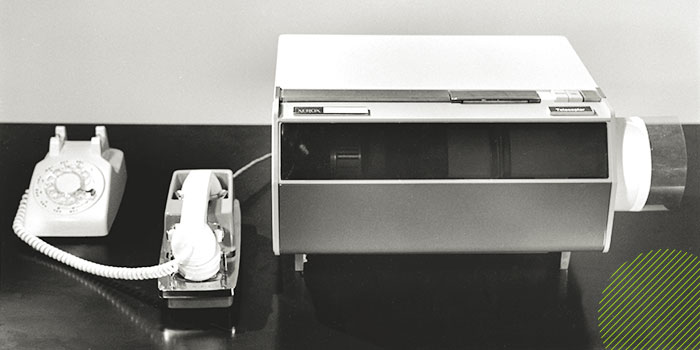
Yes, kids, people once had to set the physical phone handset into a cradle to send and receive sounds across the telephone wires. Previous generations thought it was cool.
By the 1970s, businesses had fully adopted the use of fax machines and had made them an integral part of regular work processes. No one laughed at them; no one feared them; no one fought them; no one misunderstood their effects. To fax a large document may have taken 15 minutes or more, but that was still better than taking a day or more to mail a document to someone one.
When I entered the workforce in the late 1980s, fax machines were everywhere. Where I worked, there was a fax station on every office floor or every department, often two machines—one to receive faxes and one to send faxes—and some people had their own fax machine at their desk.
The only consternations or arguments over fax machines were whose turn it was to use them. I worked at one company where the fax machines were so much in demand you had to reserve a five-minute slot to use one. This was all before e-mail attachments took over as an even quicker and easier way for most people to send documents.
The Lies in the Propaganda Image
The consultant/coach pushing AI propaganda, including the above image, relies on many younger people never experiencing the era of fax machines. Allow me to correct the specific lies in his propaganda image.
As I’ve already mentioned, there was never much, if any, fear of fax machines. People embraced their use and there were few if any negative side effects of their use. No one was running around saying it wasn’t communication; quite the opposite, everyone knew the fax machine was a boon to communication.
The propaganda image suggests that faxes were under no control or authority, and had no proof that using them went through proper channels. The truth was that in security measures, faxes were no worse than mailing paper. A company either did or didn’t have documentation control procedures, and the reality was that fax machines still moved paper documents; there was literally a paper trail. Fax machines actually improved control over documents because the machines kept logs of when documents were sent and received and of the telephone numbers on the other end of the fax transmissions. These logs were kept and audited.
Faxing did not bring “the end of the process” as the propaganda image insists, as I witnessed as a technical writer in charge of maintaining official policies and procedures documentation. People still had to create documents, still had to have document contents approved through proper channels, and still had to maintain document retention and control. Faxing only made the remote delivery of documents take less time.
The propaganda image also states that the mythical anti-fax people missed that the “medium,” “message,” and “world” changed with the fax machine. These statements are accentuated by the attached text about people “still tuned to the environment that collapsed,” an assertion attempting to link people wary of AI with the mythical timid, visionless anti-fax people.
These hyperboles are propaganda lies laced with mockery. Fax machines made transmitting information faster but didn’t change the message or even the medium of paper documents; it changed how some paper documents were exchanged. Remember that fax machines printed out paper documents; they were remote copiers. Fax machines didn’t collapse any environments. The effects of fax technology were in line with the reality that technology quickens and extends human activity but doesn’t fundamentally alter it.
Shrinking (and Weaponizing) the Information Space
Citizens are transformed into users made easier to manipulate
There Remain Legitimate Concerns about AI
The purpose of propaganda is to advance an agenda. The LinkedIn consultant/coach is using propaganda to promote his business, but he’s also promulgating the larger agendas of AI.
The real purpose of this propaganda image is to silence critics of AI. People have legitimate concerns about the design, use, and implementation of AI. People should be allowed to voice those legitimate concerns, and supporters of AI should listen.
Certain supporters of AI want to quash discussion of the legitimate concerns about AI. That’s because while AI makes it easier for users to plagiarize and otherwise be lazy, the main purpose of AI is to make money for a small handful of tech bros. The tech bros and their megacorporations divert billions of dollars from the public into their coffers, while small fish opportunists like the LinkedIn consultant/coach try to make a few bucks off the side effects.
AI is a scam; the emperor has no clothes, but there’s too much money to be made to allow dissenters to be heard. To silence critics of AI, the tech bros and their sycophants create propaganda that portrays anyone who objects to AI corporations steamrolling over humanity as timid, foolish Luddites. The image at the beginning of this article is an instance of such pompous and domineering propaganda.
The answer to propaganda is to respond with open discussion about the falsehoods of the propaganda. The best answer to wrong speech is more speech about the truths the propaganda is trying to silence. Not all propaganda is as ridiculous and obviously bogus as this image, but increased diligence and the fresh air and sunshine of open dialogue can disinfect our lives from the lies pushed by propagandists. In other words, natural intelligence can prevent the harms of Big Tech’s AI scam.
Is AI the Next Revolution? Or the Next Segway?

Applying Real Philosophy to Real Life is a reader-supported publication. To receive new posts and support my work, consider becoming a free or paid subscriber.