
The Problem with the Transgender Label
The problem is with THE LABEL and NOT with ANY person

I am going to address a touchy subject and dare to ask: what is the problem with the transgender label? There is absolutely no problem with any human being who could consider themselves “transgender.” All human beings should be accepted for who they are. No, the problem is the label itself because it is a label.
First, let us be clear about what is the issue.
To quote just one example, a UK survey found that 79% of people who self-identify as transgender experienced hate crime related to their gender identity, and 32% had experienced physical violence. Both percentages are higher than the experiences of gays, lesbians, and bisexuals. Human Rights Watch reports that deadly violence against people in the transgender community has for years been increasing. Human Rights Campaign reports in the first 11 months of 2024 30 deaths due to violence against transgender people.
People are being discriminated against, harassed, ridiculed, assaulted, and even killed because they do not fit nicely into the social stereotypes of “man” and “woman.” I put “man” and “woman” in scare quotes because genders are social constructions. In other words, the categories of “man” and “woman” mean what social norms say they mean, and those meanings differ from one society to the next and change as societies change.
This issue is not about genitalia or internal organs; this is about what people think and feel are the meanings of the concepts “man” and “woman” and the values they assign to those meanings. Values and meanings are attached to concepts and those concepts are signified by a word or label.
In this case, if a person is not acting how a “man” or a “woman” “should” act, they are widely deemed to be doing something improper. Individuals who act contrary to social norms may be treated with suspicion and hostility. Stereotypes are simple, easy ways to categorize people, and if one thinks everyone is either a “man” or a “woman” according to narrow definitions, then judging people is easy. People rely on concepts and associated labels to know how they should think, feel, and make judgments about things. Concepts and labels give a sense of security and understanding of placing things and people into categories. The simplicity of putting people into categories is why many people feel uncomfortable when others do not conform to the social categories of what a “man” or a “woman” is supposed to be.
How can we stop discrimination, hostility, and violence against people who do not conform to the narrow social stereotypes of “man” and “woman?” If the problem is judging people according to categories, then adding another category is not the answer. If “transgender” is just one more label to which society assigns values and meanings to define people, then what exactly is gained? More labels do not solve the problems created by labels. As a label designating a category, “transgender” becomes another stereotype against which individual people are judged.
The Stupid Label Wars
We can see this now in the turf war over who is allowed to use the label “transgender” and who can be considered “trans supportive,” “trans expansive” and so on. One example is the response to feminist women who argue that the life experiences of people raised as a “man” who now identify as a “woman” don’t equate with the experiences of people who were born and raised as a “woman.” There are radicals who smear those feminists as TERFs (trans-exclusionary radical feminists). Now people have another label people can fight over and use against others. As is so often the case in arguments over labels, there is more judging than listening. The vitriol between these two camps fighting over labels has been going on for years but has solved nothing.
Another example is this image, originally posted here.
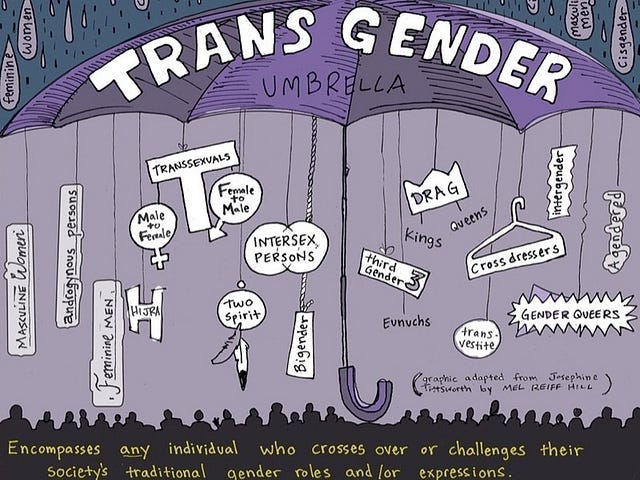
The creator of that image said that it defines what the label “transgender” means, and it supersedes the other 20 labels mentioned. Of course, being an Internet meme, some people disagreed vehemently.
Making matters worse, the meme’s creator set out the label “transgender” as the way to fend off the rest of the world and adds that the “transgender” label is reserved for people who “cross over or challenge” traditional gender roles. This claim opens up the argument over who is adequately crossing over or challenging gender roles.
This is when labels do the most damage — when they are value judgments. The label is no longer descriptive but evaluative, enabling the dismissing judgment of “you can’t call yourself ‘transgender’ because I don’t think you depart enough from traditional gender roles.”
What Labels Actually Do
Obviously, not everyone is using the transgender label as a weapon to divide and subjugate, but the problem remains. To adopt a label is to define yourself or others by it, diving people into two (or more) groups. Labels can be helpful, but they can also be harmful.
Too often, people use labels not to clarify and affirm but to classify and dismiss. People are discriminated against either because they are seen to not fit into a category judged as appropriate or because they are seen to fit into a category that is judged as different and inferior. Adding the label “transgender” has added yet another category for people to argue about and stereotypes to judge others as being in some way inferior.
Labels are frequently used to justify and maintain power relations. In addition to handing right-wingers yet another label with which to further stigmatize and repress already marginalized people, it hands people who would adopt the transgender label an excuse to exclude others they deem not “transgender enough.”
There are now people pushing the labels “cisgender,” “cismale,” and “cisfemale” in defamatory ways. We hear these terms thrown about as insults or derisive dismissals of people — “you are just cismale.” We already have a label, should we need one, for a traditionally-minded male who opposes “transgender” people: “bigot.”
What Actually Matters
The question we need to address is this: are we going to argue over labels or are we going to deal with individual people for who they are?
The biggest problem with the transgender label is that it tells us to think in terms of a label rather than in terms of individuals. We need to celebrate the reality that all individual expressions are valuable, at the same time acknowledging individuals’ particular experiences and challenges, avoiding the backhanded bigotry of the “all lives matter” type of sentiments.
This last point is important because those individuals who diverge from the stereotypes of “man” and “woman” face different challenges than those who do not. These experiences are part of what some well-meaning people are trying to cover with the label “transgender,” but despite good intentions, the label is a weak umbrella that does not address individuals as individuals and ultimately covers no one.
What labels me, negates me.
― Søren Kierkegaard
There is no one “transgender” experience; there are as many different experiences as there are individuals. Let’s respect individuals by not subsuming them under a label but instead listening to and respecting them as individuals with their own unique experiences.
Adding more labels only serves to divide and obfuscate rather than clarify. The transgender label does not stop discrimination, harassment, ridicule, or violence. The only way to do that is recognizing other individuals as having value for who they are.
Ultimately, it should not matter how one dresses, what toys a child plays with, what name one wishes to call oneself, and so on. Who someone is as an individual person is what should matter. Instead of labeling people, we should listen to them. Instead of labeling yourself, you should be yourself. Those are the attitudes and actions that will stop discrimination because only then will we break out of the mindset of categorizing and judging people we have reduced to labels.