
Two Things People Get Wrong about Descartes
Getting past groupthink in philosophy

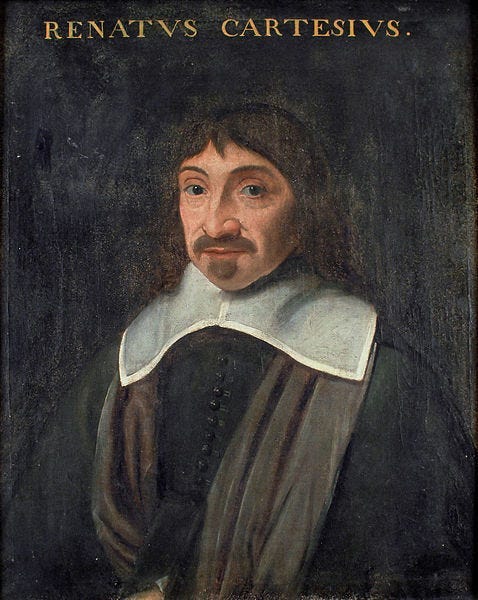
Beware of common wisdom. You, me, and pretty much everyone else for several centuries has been taught two untruths about the philosophy of René Descartes. Teaching and talking about philosophers’ ideas need to be connected with what the philosophers actually thought rather than repeating what commentators have said.
I will set the record straight on two aspects of Descartes’ philosophy that are frequently misrepresented.
The Cogito
French philosopher René Descartes (1596–1650) is one of the few philosophers who is a household name. He is best known for the most famous quote in philosophy: Cogito, ergo sum — “I think, therefore I am.”
But what did Descartes mean by the Cogito? What was he trying to accomplish with this declaration? His motives are a bit different from what the common wisdom tells us — that he was trying to prove that he exists.
A common minor misunderstanding is that Descartes was using a method of doubt. I wrote about that years ago here, explaining that his actual method was one of scientific certainty.
Always for Descartes, the purpose of his doubts is to clear the way for more certain beliefs. He believed in scientific observation, but he acknowledged that our senses frequently deceive us and lead us to untrue beliefs, so we should not trust them completely. He therefore suspends belief in every thought that comes from sense experience.
Where does completely disbelieving sense experience leave him? He has to consider the possibility that there is actually no external world, no other people, no God. He has to consider the possibility that he has no physical body and that he is mistaken to believe that there is anything material. All of these beliefs could be caused by a deceiver, a very powerful and very cunning being that uses its great power to deceive him into believing as true what is actually false.
At this point, Descartes borrows (without attribution) Augustine’s argument against the skeptics that he exists and knows that he exists. Augustine said, “If I am mistaken, I exist.” Descartes’ formulation is only slightly different: “If I am deceived, I exist.”
Doubtless, then, I exist, since I am deceived; and, let him deceive me as he may, he can never bring it about that I am nothing, so long as I shall be conscious that I am something. So that it must, in fine, be maintained, all things being maturely and carefully considered, that this proposition “I am, I exist,” is necessarily true each time it is expressed by me, or conceived in my mind. (Meditations II.3)
That’s where most people, even experts writing textbooks, stop. “Descartes proved he exists,” they say, as if that’s all Descartes said. He went on.
Being a true philosopher, knowing that he exists is not enough for Descartes. He next asks what he is. A person? A body? A thing that senses? All of these thoughts can be doubted because perhaps the various bodily sensations he has are because he is dreaming. In dreams he “sees” and “hears” things that are not real. How can he tell when he is dreaming or awake? It’s not so simple to tell the difference. But of one thing he can be certain:
Thinking is another attribute of the soul; and here I discover what properly belongs to myself. This alone is inseparable from me. I am — I exist: this is certain; but how often? As often as I think; for perhaps it would even happen, if I should wholly cease to think, that I should at the same time altogether cease to be. I now admit nothing that is not necessarily true. I am therefore, precisely speaking, only a thinking thing, that is, a mind, understanding, or reason, terms whose signification was before unknown to me. I am, however, a real thing, and really existent; but what thing? The answer was, a thinking thing. (Meditations II.6)
He concludes that he is not a body; he is “a thinking thing.” “But what is a thinking thing?” he asks. “It is a thing that doubts, understands, [conceives], affirms, denies, wills, refuses; that imagines also, and perceives.” (Meditations II.8)
The common misconception about his statement Cogito, ergo sum is that Descartes’ purpose is to prove his existence. Instead, his purpose is to demonstrate what sort of being he is. In the argument, “I think, therefore I am,” Descartes assumes the “I” — his existence — prior to the exercise. He immediately proceeds from affirming his existence to affirming that “I am therefore, precisely speaking, … a thinking thing.” (Meditations II.6) The end goal and conclusion are to know what sort of being he is.
That is what we humans are — thinking things. That’s what Descartes claims distinguishes us as humans from all other things. The essence of being human is thinking. There is an element of Aristotelianism in Descartes’ conclusion. If the essence of being human is to be a thinking thing, then our purpose is to think as excellently as possible. But more important for Descartes’ purpose is the conclusion that his essence is a thinking thing. He is a mind, not a body, whether or not he has a physical body. Descartes’ first bedrock of certain knowledge is that he is a thinking thing. On this thought he cannot be mistaken.
The Mention of God
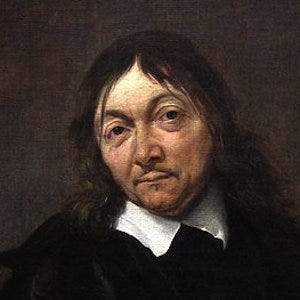
Ever since Descartes published his book, Meditations, he has been accused of committing a fallacy of circular reasoning with his argument that God is the guarantor of the truth of our belief in an external world. Descartes’ argument has ever since been derided as the “Cartesian circle.” The problem is that the so-called Cartesian circle is a misrepresentation of what Descartes is actually arguing.
The accusation against Descartes is that he asserts that the existence of God verifies that clear and distinct ideas must be true. So those who argue the Cartesian circle position are claiming that Descartes is arguing the following:
I have a clear and distinct idea of God as a perfect being.
God, a perfect being, is not a deceiver and would not allow me to be mistaken about my clear and distinct ideas.
Therefore, I can be certain of the truth of my clear and distinct ideas.
As the Encyclopedia Britannica states it (I think a reasonable summation of the standard interpretation of the alleged Cartesian circle):
But Descartes cannot know that this proof does not contain an error unless he assumes that his clear and distinct perception of the steps of his reasoning guarantees that the proof is correct. Thus the criterion of clear and distinct perception depends on the assumption that God exists, which in turn depends on the criterion of clear and distinct perception.
This is a valid assessment of the argument stated above. The Cartesian circle claim is that Descartes asserts premise 1 but that that premise depends on his conclusion, 3 — a circular argument and fallacious.
The question though is whether that is an accurate portrayal of Descartes’ actual argument. Garrett Thomson in his excellent book Bacon to Kant argues that it is not. Understanding Descartes’ argument correctly dissolves the objection that his argument is circular.
To understand Descartes correctly you need to realize that he does not begin his argument by asserting God. In fact, God is an afterthought for Descartes. He trots out God only in support of a larger argument that seeks to prove that he can have knowledge about things external to his mind.
Descartes has affirmed that his mind can know that something is true if and only if it presents to his mind clearly and distinctly.
There is nothing that gives me assurance of its truth except the clear and distinct perception of what I affirm … and accordingly it seems to me that I may now take as a general rule, that all that is very clearly and distinctly apprehended [perceived] is true. (Meditations III.2)
Descartes has now achieved his ultimate bedrock of certainty: He can accept as true those ideas that are clear and distinct. He has established the unassailable idea that he exists. He knows with equal certainty that he is a thinking thing and that his mind is capable of making judgments about external objects. He is aware that to have a method for success in science he still needs to establish a reliable connection between the ideas in his mind and the external world.
Descartes says there are three types of ideas in the mind — ideas innate or inherent to the mind, ideas invented by the mind, and ideas caused by external forces. Innate ideas cannot be doubted because we cannot think of them without at the same time thinking that they are true. That a circle is round is his example. Ideas we invent cannot be doubted because if you imagine a purple unicorn, that idea exists only as your idea, so it is neither true nor false; it simply is.
Ideas caused by external forces can be doubted. The natural light of reason, Descartes says, only illuminates innate ideas such as the idea that he exists; it does not illuminate the idea that there is a tree over there.
Here is the dilemma. I can be certain that I think I see a tree, but how can I be certain that the content of my idea is an accurate description of what exists outside my mind? I cannot doubt that I exist or that I can imagine fictitious animals, but how can I believe beyond doubt any of my ideas of an external world that exists more or less as it appears to my senses?
Knowledge is a relation between a knower and what is known. Descartes has proven that he can be certain of the knower side of the equation, that he is a thinking thing who has clear and distinct ideas, but what he is much less certain of is the cause of any of his ideas about the external world. The problem facing Descartes is that what exists in his consciousness are his own ideas about external objects but not what causes those ideas. He cannot deny that he has many ideas about objects that seem to exist in the world external to him. These ideas of external objects that are given to his mind by his senses sometimes seem to be clear but later prove to be false. So, he still needs to solve the big problem of the unreliability of sense perception before he can reach the experiential form of cognitive understanding that we call “science.”
To establish the certainty needed for science, Descartes first establishes his foundational principle that “ideas that are clear and distinct must be true.” Everything else that he argues follows from that proposition. Any idea that can be said to be clear and distinct must be accepted as true; for example, “I think, therefore, I am, I exist.” I have a clear and distinct idea that I exist, and this must be accepted as true.
The proposition that clear and distinct ideas must be true is true (or false) independent of God. It is significant that Descartes establishes the proposition of the clear and distinct idea before he turns to the idea of God and then only to counter the possibility that all of his ideas about external objects are placed in his mind by a deliberate deceiver. Descartes knows he exists, but what can he know about the external world? He has ideas that an external world exists, but he could be mistaken, dreaming, or deceived by a powerful being.
Descartes is trying to prove that his ideas about an existent external world aren’t completely false. Thomson portrays Descartes’ reasoning in this way:
Ideas that are clear and distinct must be true.
I have a clear and distinct idea of God.
Therefore, God must exist.
Because my idea of God includes his perfection, God is trustworthy.
Therefore, I cannot be deceived about the existence of the external world because God would not allow me to be deceived.
It is important to accept that, in Descartes’ actual argument, premise 1 does not depend on premise 3. The Cartesian circle accusation is based on incorrectly flipping these two premises. The idea of God is a clear and distinct idea and thus God’s existence cannot be doubted, just like our own existence and every other clear and distinct idea cannot be doubted. Obviously, Descartes’ assumption of a clear and distinct idea of God can be questioned, but nowhere does he claim that God guarantees his clear and distinct ideas.
As Thomson puts it on p. 35, “God is introduced to meet our general systematic doubts.” We can, as Descartes points out, doubt each of our perceptions and beliefs about external objects because we know our senses can trick us. More disturbing than our senses being unreliable in particular instances is the possibility, which Descartes establishes earlier in Meditations, that an evil deceiver could be tricking us into believing there is an external world when, instead, they are all false images in our mind.
Descartes is not saying that he cannot be mistaken about particular propositions such as “that tree looks safe to climb” because he knows his sense perceptions can be mistaken. But because he knows he is a thinking thing who can use the power of reason and because he knows God is not an evil deceiver, then knowledge from experiencing an external world is possible. In other words, while we can and should doubt any particular sense perception, we do not and cannot doubt the entirety of our perceptions of the external world.
Thus, if he can reason correctly (according to his four rules for directing the mind), then his mind is incapable of error because he can reason from clear and distinct ideas to truth. We still must be on guard to not make mistakes in our sensory perceptions of the world, but we can rely on the knowledge that an external world does exist more or less as it appears to exist, and that means that science is possible. Establishing, in the 1600s, the validity of the nascent observational science was Descartes’ primary purpose.
Descartes’ argument can be questioned on several of its premises, but it is not circular reasoning.
Interesting post! I like the project of debunking the myths about Descartes, but I'm not sure about the circularity. It seems like premise 1 does depend on 3 when you take into account he says the evil demon/genius could thwart him every time he does simple arithmetic or simple deductions. It's almost like he's calling extremely short term memory into question. So clear and distinct ideas such as simple math don't seem to escape the evil genius, and it's not clear even the cogito passes that test. But even if we grant the cogito passes, he still has to demonstrate God's existence and that God is no deceiver in order to assure his mathematical and logical clear and distinct ideas are true. But of course God is also a clear and distinct idea.
I wrote about a series of posts on Descartes a while back, though I wasn't focusing on the circularity issue, so maybe there's something I missed.
https://philosophyandfiction.substack.com/p/how-do-you-know-whats-really-real?r=schg4&utm_campaign=post-expanded-share&utm_medium=web