
Why I Quit Academia
For years I had kept one foot in academia; I’ve now taken that foot out and can walk freely

The writing was on the wall when in April 2025 a university official sent an e-mail announcing that textbooks would be censored. They didn’t use the word “censored,” of course — their preferred euphemism was “curricular restructuring.”
Before I go any further, I will acknowledge that the university did a good job of creating plausible deniability. I suspect lawyers were consulted. Weasel words were deftly applied, but, in my opinion, having taught at this university for 13 years, the shift in language and tone clearly signaled their intent to submit before being asked, or, as historian Timothy Snyder calls it, “anticipatory obedience.”[1]
To be fair, 2025 was a challenging year for higher education. Pressures were applied to education institutions to obey an authoritarian whitewashing of curricula and pedagogy. The end of academic freedom was part of the Project 2025 right-wing agenda to remake the US.[2]
I thought my small private university would stand strong against the Project 2025 agenda. I appear to have been mistaken.
My History Briefly Told
This past year, 2025, was my 21st year of teaching philosophy and my 13th year at my now former university. I love teaching, and I love philosophy. I especially love those moments when it clicks for students, when they realize that philosophy applies to real life and are excited to see how philosophy can directly benefit their lives. Those are beautiful moments.
I have never loved academia and its “ivory tower.” Universities suffer from the same problems endemic to all social institutions — calcification of policies and procedures, nepotism, and groupthink. I’d say that all of those are worse problems in academia, especially the rampant nepotism causing who you know and where you went to school to matter far more than the quality of your ideas, research, or teaching.
One of my firm career decisions has been to not seek a full-time faculty position. Part-time is fine, thank you. Sure, I was paid less than half of what a full-time position pays, but what is the price of freedom? I’ve seen the nasty office politics of academia and the extracurricular bureaucratic tasks that universities demand from full-time faculty. I’ve heard from my colleagues and from their students how those demands leave professors less able to prepare to teach their courses. The students suffer.
I kept one foot in academia out of love for helping my students, and one foot outside of academia out of love for the freedom to pursue other things. Ironically, as a part-time adjunct professor, I’ve been more free to focus on my students and facilitate their learning. That is what education is supposed to be about — learning. Higher education has lost its focus on helping students to learn and develop interpretative thinking skills, as I’ve written about multiple times. The growing corporatization and tilt toward the right wing in higher education has worsened these endemic problems. Still, although the job of a philosophy professor has been becoming increasingly difficult, I soldiered on because I enjoy those epiphanic moments my students have, and I wanted to help them reach those understandings.
A Chill Descended
The April e-mail about curricular restructuring stated that professors are supposed to assign only particular preapproved textbooks to their students. In all my 13 years with the philosophy department, we had been free to adopt the textbooks best for our students. The April e-mail threatened to end that academic freedom.
The official explanation was that the preapproved textbooks would meet expectations (whose and which were not specified), and the e-mail claimed that these particular books were chosen because the full-time professors had previously used them. I was familiar with the textbooks on the preapproved list. The textbooks were the bland, barren, corporate texts that I refused to use — no surprise there. I was also not surprised that I was able to verify in the documented textbook adoption history for our university that, contrary to the e-mail’s claim, these books had never been used by the full-time professors.
The e-mail announcing the preapproved textbook list came shortly before the deadline to adopt textbooks for the upcoming semester. I had already entered into the school’s system my chosen textbook, one not on the list. The system reported that none of the other professors in the department changed their adopted textbooks to ones on the list. So, I also didn’t change my textbook. Events over the next semester made it clear, in my opinion, what the list and its curricular restructuring was actually about, and that I was being singled out.
The Textbook
First, let me explain the textbook I have used in my introduction to philosophy courses. College students enter introduction to philosophy courses with little to no prior exposure to philosophy. Most K–12 schools don’t have the courage to teach philosophy. American society has a habit of portraying philosophy as something either boring or weird. The first task in any introductory philosophy course is to overcome the stigma and encourage students to engage with the topic. In case you don’t know, introduction to philosophy fulfills a general distribution requirement, so most students take the course only because it is required. They don’t know what philosophy is, and they are primed to think a philosophy course is, at best, a necessary burden.
The philosophy textbook offerings from the Big Four educational publishing corporations (Cengage, McGraw Hill, Pearson, and Oxford) are inadequate for the task.
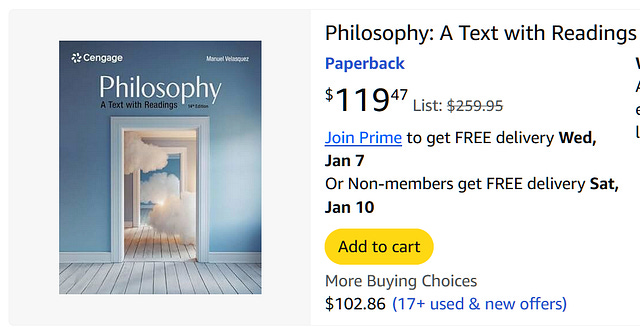
The books are overpriced, often over $100 a copy; they dumb down philosophy; they don’t provide the needed social and historical context of the philosophers’ ideas; and they don’t accurately portray what philosophers do or how philosophers interact with society. They also fail to place philosophy in the present day or encourage students to think creatively. The corporate textbooks sustain the false perception that philosophy is the boring study of dead white guys detached from the world and arguing over questions largely irrelevant to our lives.
For years, I tried to make the corporate textbooks work for my students. My job as a professor was to help them learn and think for themselves, which meant struggling to remedy the shortcomings of the existing books. One class session, a student of mine suggested I write my own philosophy textbook. It took me a few years to research and write the book, but I did. My first philosophy textbook was published in 2021, with an improved version the following year. I’ve used the textbook I wrote in my courses since 2021 with the knowledge and approval of my department and university.
My department and my university had no problem with my textbook in 2021. They also had no problem with my textbook in 2022, 2023, or 2024.
Suddenly, in 2025, there was a problem with my textbook.
Gee, Why?
To make a long story short, it seems apparent to me that one purpose of the curricular restructuring was to remove certain subjects from the philosophy curriculum. I won’t detail all of the events of the last few months that brought me to that opinion, some events creating what I perceive as a hostile work environment. I will focus on the primary issue.
Among many other subjects important to the history of Western philosophy, my textbook covers the subjects of critical theory, postmodernism, feminism, racism, postcolonial theory, and nonheteronormativity. It presents to students these and other subjects in an evenhanded manner that empowers students to make up their own minds about the philosophers’ ideas. My textbook also focuses more on recent and current philosophers than on ancient ones. It replaces the dusty, dead, and empty syllabus of the corporate textbooks and makes philosophy real and vital for students. I encourage students to think for themselves and understand that many philosophers have developed valuable ideas for us to use in our daily lives. The vast majority of my students loved learning about these subjects and how they were asked to engage with the philosophers’ ideas.
This pedagogy seems to threaten some people. Some of the subjects in my textbook are ones that Project 2025 and the bulk of the right wing label as “woke” and urge those subjects to be eliminated from the curriculum. Such curricular restructuring is a small part of the right wing’s larger agenda to suppress any discussion of ideas outside of a narrow set of doctrines held by a small set of the population. The right-wingers call what they are doing “anti-DEI.” Others might call it discrimination.
Again, I won’t detail the events of the last few months that brought me to feel singled out as the only professor pressured to surrender their academic freedom and textbook of choice. Suffice to say that the subjects in my textbook condemned by the right wing are absent from both the textbooks listed as preapproved in the April 2025 e-mail and the textbooks used by other professors in the department.
Regardless of who was behind the pressure and why, I was faced with a choice professors shouldn’t have to make. With deep sadness, I quit rather than give in to censorship curricular restructuring. Either way, my students lose their academic freedom and their right to a robust education, but I’d rather not be complicit in that.
The Silver Lining
It’s not pleasant to feel betrayed by those you once trusted. I will miss a job I enjoyed and the students who appreciated what I did. But I am also walking away from limits. I knew back in April that I would eventually have to quit my university. For several years, there seemed to have been a shifting away from a liberal arts mindset. More and more vice presidents with unclear duties were being hired. There was increased emphasis on retaining income for the university and less on requiring academic excellence from students. The April e-mail suggested to me a deeper surrender. It said to me that they didn’t want professors; they wanted babysitters.
My teaching job was only part-time, but I was, in effect, always on call, and walking away from the job gives me that much more time and mental space to research and write. I am now free to write what I want without worries about being censored or targeted. Also, I am now free from conflicts of interest and able to deliver my philosophy course online for people who are interested in how real philosophy applies to real life. Look for details coming soon.
In mid-September, I drafted a resignation letter and scheduled it to be e-mailed to my department chair the day in December on which the semester ended. Two days later in September, I was contacted by someone who had read one of my articles, and, after a brief exchange of messages, he offered me a management position with a research organization. It is also a part-time job, but with the academic freedom and respect that I no longer had at my now former university.
That new job opportunity affirms that sometimes you have to let go of something to make room for something better. For the sake of a salary, I had held on to a job in which I was increasingly disrespected; it was sapping my soul. No longer. Now, I can walk freely.
[1] Timothy Snyder, On Tyranny: Twenty Lessons from the Twentieth Century, 17.
[2] Heritage Foundation, Mandate for Leadership: The Conservative Promise, 319 cf.
How We Are and How We Got Here: A Practical History of Western Philosophy
A fresh and original presentation that is easy and affordable for students, instructors, and general readers to use…amzn.to
The sad thing is that my situation is not that unusual. Similar incidents are happening across the country as good teachers and their students are muzzled and sidelined. This is what academia in corporatized higher education has become.
It sounds like college is now little different than corporate America. I wouldn't want to go to college now, and I think that's what certain powers want people to think. It wasn't like that years ago, and I am afraid it won't return to when one could get a real education uncontaminated by right-wing ideology.